
Product Description
DN250 10″ Universal Wide Range Flexible Ductile Iron Straight Coupling
| MATERIALS | ||
| ITEM | PARTS | MATERIAL |
| 1 | Body | BSEN1563 EN-GJS(QT)-450-10/Carbon Steel |
| 2 | Gland | BSEN1563 EN-GJS(QT)-450-10 |
| 3 | Seals | EPDM/NBR |
| 4 | Fasteners | Stainless Steel/Carbon Steel with Dacromet Coating/GAL Carbon Steel |
| 5 | Coating | Fusion Bonded Epoxy |
| DIMENSIONS(PN10/PN16) | ||||||||||
| DN | RANGE | L | L1 | H | ID | ID1 | OD | N-MSXL1 | BOLT TORQUE | WIGHT(KG) |
| (mm) | (mm) | (mm) | (mm) | (mm) | (mm) | (mm) | (mm) | (Nm) | ||
| 50 | 59-72 | 188 | 148 | 95 | 72 | 76 | 153 | 4-M12*180 | 55-65 | 4.1 |
| 65 | 72-85 | 188 | 148 | 95 | 85 | 89 | 173 | 4-M12*180 | 55-65 | 4.1 |
| 80 | 88-103 | 188 | 146 | 95 | 103 | 107 | 185 | 4-M12*180 | 55-65 | 4.1 |
| 100 | 109-128 | 188 | 146 | 95 | 127 | 132 | 208 | 4-M12*180 | 55-65 | 4.6 |
| 125 | 138-153 | 198 | 153 | 95 | 158 | 162 | 256 | 4-M12*190 | 55-65 | 8.3 |
| 150 | 159-182 | 198 | 153 | 95 | 182 | 186 | 280 | 4-M12*190 | 55-65 | 8.5 |
| 175 | 189-212 | 233 | 187 | 130 | 211 | 216 | 329 | 4-M12*225 | 55-65 | 9.0 |
| 200 | 218-235 | 233 | 187 | 130 | 234 | 239 | 333 | 4-M12*225 | 55-65 | 10.6 |
| 225 | 242-262 | 233 | 185 | 130 | 261 | 265 | 379 | 6-M12*225 | 55-65 | 14.5 |
| 250 | 272-289 | 233 | 186 | 130 | 288 | 295 | 391 | 6-M12*225 | 55-65 | 15.4 |
| 300 | 315-349 | 233 | 187 | 130 | 349 | 352 | 464 | 6-M12*225 | 55-65 | 20.0 |
| 322-339 | 233 | 187 | 130 | 338 | 345 | 444 | 6-M12*225 | 55-65 | 23.1 | |
| 338-360 | 233 | 187 | 130 | 359 | 366 | 460 | 6-M12*225 | 55-65 | 23.1 | |
| 350 | 351-391 | 250 | 187 | 130 | 390 | 395 | 502 | 10-M12*225 | 55-65 | 26.8 |
| 400 | 400-442 | 250 | 187 | 130 | 441 | 446 | 558 | 10-M12*225 | 55-65 | 31.9 |
| 450 | 455-493 | 250 | 187 | 130 | 492 | 497 | 608 | 10-M12*225 | 55-65 | 36.6 |
| 500 | 500-599 | 250 | 187 | 130 | 598 | 594 | 662 | 10-M12*225 | 55-65 | 40.0 |
| 600 | 600-692 | 250 | 187 | 130 | 691 | 697 | 768 | 10-M12*225 | 55-65 | 42.0 |
| 700 | 708-780 | 250 | 187 | 130 | 779 | 785 | 910 | 10-M12*225 | 55-65 | 45.0 |
/* March 10, 2571 17:59:20 */!function(){function s(e,r){var a,o={};try{e&&e.split(“,”).forEach(function(e,t){e&&(a=e.match(/(.*?):(.*)$/))&&1
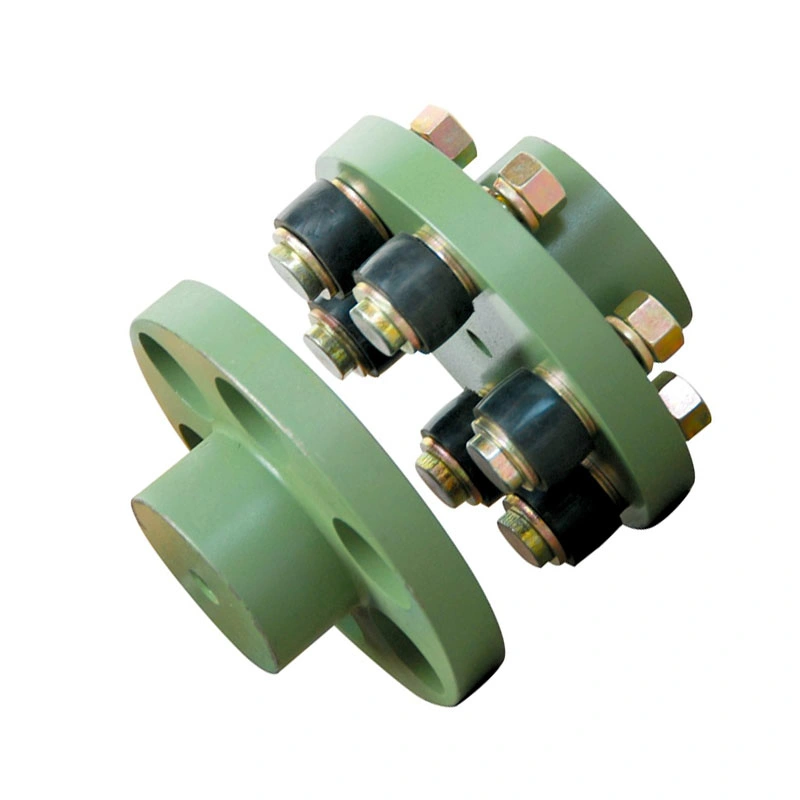
What role does a flexible coupling play in minimizing wear and tear on connected components?
A flexible coupling plays a vital role in minimizing wear and tear on connected components by absorbing and mitigating various mechanical stresses that occur during operation. Here’s how a flexible coupling achieves this:
- Misalignment Compensation: One of the primary causes of wear and tear on rotating machinery is misalignment between connected shafts. Misalignment can occur due to factors such as thermal expansion, foundation settling, or assembly errors. A flexible coupling can accommodate both angular and parallel misalignments, reducing the stress on the shafts and connected components. By allowing for misalignment, the coupling prevents excessive forces from being transmitted to the connected components, minimizing wear.
- Vibration Damping: During operation, rotating machinery can generate vibrations that lead to accelerated wear on components like bearings, gears, and couplings. A flexible coupling acts as a vibration damper, absorbing and dispersing vibrations, reducing their impact on connected components. This damping effect helps prevent fatigue and extends the life of the components.
- Shock Absorption: Machinery may experience sudden shocks or impact loads during start-ups, shutdowns, or due to external factors. A flexible coupling is designed to absorb and cushion these shocks, preventing them from propagating through the system and causing damage to sensitive components.
- Smooth Torque Transmission: In rigid couplings, torque transmission between shafts can be abrupt and cause torque spikes. These spikes put stress on the connected components, leading to wear and fatigue. Flexible couplings transmit torque smoothly, without sudden spikes, ensuring even distribution of forces and reducing the wear on components.
- Controlling Torsional Vibrations: Torsional vibrations, a type of vibration that affects rotating shafts, can be damaging to connected components. Some flexible couplings are designed to address torsional vibration issues, providing additional protection against wear and tear.
- Compensating for Thermal Expansion: Temperature fluctuations can lead to thermal expansion or contraction of machinery components. A flexible coupling can accommodate these changes, preventing undue stress on the connected components that may arise from differential expansion rates.
By performing these functions, a flexible coupling acts as a protective barrier for connected components, minimizing wear and tear, and contributing to their longevity. The reduced wear and stress on the components also result in lower maintenance costs and improved overall reliability of the mechanical system.
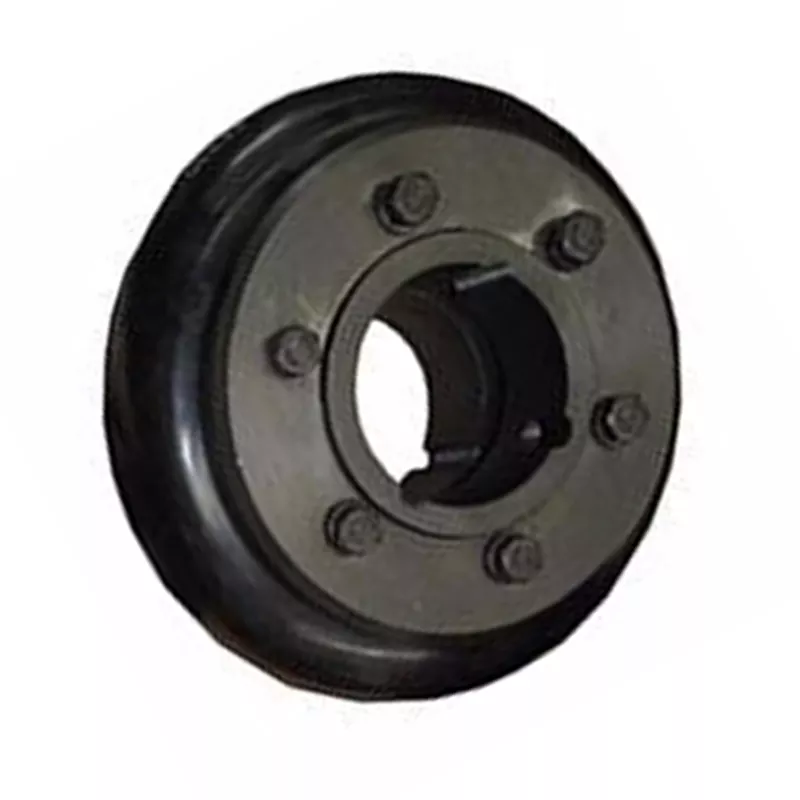
Can flexible couplings be used in pumps, compressors, and fans?
Yes, flexible couplings can be used in pumps, compressors, and fans, and they are commonly employed in these types of rotating machinery. Flexible couplings offer several advantages that make them suitable for such applications:
- Misalignment Compensation: Pumps, compressors, and fans often experience misalignments due to various factors, such as thermal expansion, foundation settling, or component wear. Flexible couplings can accommodate angular, parallel, and axial misalignments, helping to maintain proper alignment between the driving and driven components.
- Vibration Damping: Flexible couplings help dampen vibrations in rotating machinery, which is essential for smooth operation and reduced wear on components. In pumps, compressors, and fans, vibration control is crucial to prevent premature failure and maintain reliable performance.
- Shock Load Absorption: These rotating machines may encounter shock loads during startup or shutdown, especially in reciprocating equipment like reciprocating pumps or compressors. Flexible couplings can absorb and mitigate the impact of such loads, protecting the connected equipment from damage.
- Reduced Maintenance: Flexible couplings with elastomeric elements or other self-lubricating features require minimal maintenance, leading to cost savings and reduced downtime in pumps, compressors, and fans.
- Energy Efficiency: Certain flexible coupling designs, such as beam couplings or certain elastomeric couplings, have low mass and inertia. This characteristic helps improve the energy efficiency of rotating machinery, which is particularly beneficial in large-scale pumps, compressors, and fans used in industrial applications.
- Adaptability: Pumps, compressors, and fans often have varying operating conditions and load profiles. Flexible couplings are adaptable to different operating environments, making them suitable for diverse applications.
In summary, flexible couplings offer several performance-enhancing features that make them well-suited for use in pumps, compressors, and fans. Their ability to accommodate misalignment, dampen vibrations, absorb shocks, and reduce maintenance requirements contributes to improved reliability, efficiency, and longevity of the connected rotating machinery.
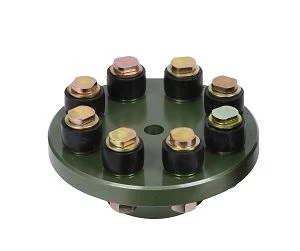
Can flexible couplings be used for both motor-to-shaft and shaft-to-shaft connections?
Yes, flexible couplings can be used for both motor-to-shaft and shaft-to-shaft connections in various applications. The versatility of flexible couplings allows them to adapt to different types of connections and meet the specific requirements of the system.
Motor-to-Shaft Connections:
When connecting a motor to a shaft, a flexible coupling serves as an intermediary component that joins the motor shaft and the driven shaft. Flexible couplings are commonly used in motor-driven systems to accommodate misalignment between the motor and the driven load. In motor applications, flexible couplings help reduce stress and wear on the motor bearings, thus extending the motor’s life and enhancing overall system reliability. They also act as vibration dampeners, minimizing vibrations transmitted from the motor to the driven shaft, and subsequently to connected equipment, ensuring smoother operation.
Shaft-to-Shaft Connections:
In many mechanical systems, such as those in the manufacturing, automation, and power transmission industries, shaft-to-shaft connections are required. A flexible coupling can bridge the gap between two shafts and transmit torque while accommodating misalignment. This type of coupling is commonly used to connect shafts that are not perfectly aligned due to factors like manufacturing tolerances, thermal expansion, or foundation settling. By allowing for misalignment, the flexible coupling protects the connected components from excessive stresses and ensures efficient power transmission.
Versatility and Advantages:
The ability of flexible couplings to handle both motor-to-shaft and shaft-to-shaft connections makes them versatile solutions for a wide range of industrial applications. Some of the advantages of using flexible couplings in these connections include:
- Minimizing stress and wear on connected components, such as bearings and seals.
- Compensating for misalignment, ensuring smooth power transmission.
- Damping vibrations and shock loads, reducing the risk of mechanical failures.
- Protecting equipment from excessive forces, enhancing system reliability.
- Simplifying installation and alignment procedures, reducing downtime.
- Improving overall system performance and operational efficiency.
Applications:
Flexible couplings find applications in a wide range of industries, including manufacturing, material handling, automotive, aerospace, robotics, and more. Whether connecting a motor to a shaft or joining two shafts directly, flexible couplings play a crucial role in enhancing the reliability and efficiency of rotating machinery and mechanical systems.
In conclusion, flexible couplings can effectively serve as connectors for both motor-to-shaft and shaft-to-shaft connections, providing essential misalignment compensation and protection for connected equipment in various industrial applications.


editor by CX 2024-01-09